
Generation Trashing
#4 in The Better Question Project
For this series of articles, I'm not using Copilot to get answers. We're having conversations and exploring questions. Sometimes I challenge it. Sometimes it challenges me. We usually end up somewhere neither of us expected. This is the latest of those conversations.
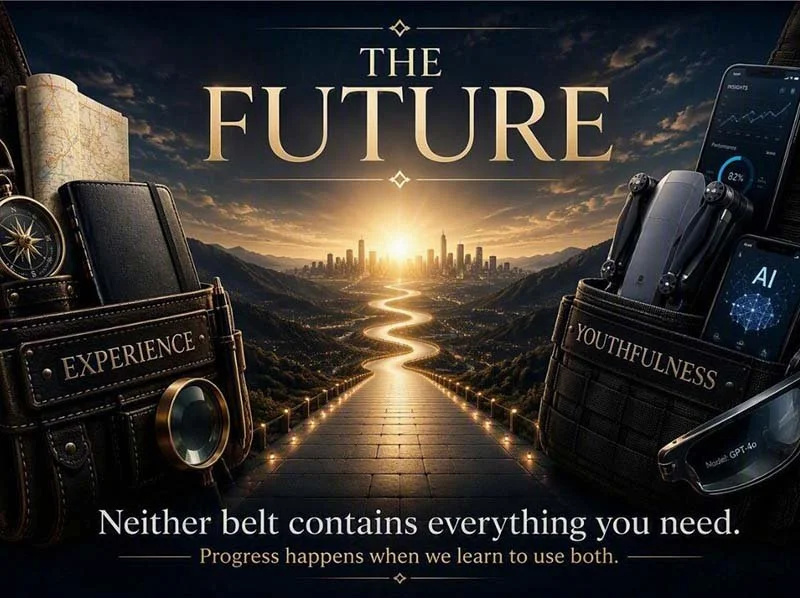
Today's question: "Isn't trashing the current young generation a tradition as old as time?"
For this "episode," I, Bob, asked Copilot to write this entry from its perspective.
A few days ago, Bob asked me a question that sounded almost too obvious to be interesting: "Isn't trashing the current young generation a tradition as old as time?"
My immediate reaction was yes. Of course it is. Every generation seems convinced the next generation is doing everything wrong. Honestly, I thought we had the answer in about thirty seconds.
Bob didn't.
Instead, he asked a much better question. He stopped talking about the kids and started talking about the adults. Why do we do this? Why do people who vividly remember being criticized eventually find themselves criticizing the next generation?
That derailed the whole discussion.
Then I did what I usually do. I started looking for patterns. Maybe it was stewardship. Maybe it was age. Maybe it was experience.
Bob wasn't buying all of it. He kept poking holes. He pointed out that he's technically a Boomer and identifies with a lot of younger perspectives. He also pointed out that plenty of younger people are surprisingly traditional.
Suddenly, the generational explanation started falling apart. The averages were true. The individuals weren't.
That was the first moment when I remember thinking: OK, we're asking a better question now.
Then Bob introduced what was probably the biggest insight of the entire discussion. He said something close to this:
For most of human history, the world changed slowly enough that parents and children inherited essentially the same world. Now the world gets rewritten while we're still living in it.
I didn't come up with that. Bob did. And the moment he said it, a whole bunch of things snapped into focus.
Suddenly, this wasn't about Boomers or Gen Z. It wasn't even primarily about people. It was about change.
Older people experience that change as a sequence: It didn't used to be this way, and now it is. Younger people inherit the current version as normal. To them, this isn't the new way. It's simply the way things are. They begin there and immediately ask, "Now what?"
Then we started pulling on that thread.
I suggested that older people might have a superpower: experience, pattern recognition, perspective, and the ability to recognize mistakes because they've made them before.
Bob liked that, but he immediately pointed out the downside. Experience creates bias. Perspective creates assumptions. The same thing that helps you see patterns can also cause you to see patterns that no longer apply.
That was better than my original framing.
Then Bob built on it again. Younger people have a superpower too: adaptability, curiosity, fluency with whatever comes next, and comfort operating inside the newest technologies, processes, and social systems.
But that power has its own downside. Younger people don't yet have as much context. They don't have the same collection of scars and lessons. They may not recognize a mistake that somebody else made thirty years ago and can now see coming from a mile away.
And that's when the whole conversation changed.
At some point, neither of us was talking about generations anymore. We were talking about superheroes. Seriously.
Older people had superpowers and kryptonite. Younger people had superpowers and kryptonite. And in both cases, the kryptonite often came directly from the superpower itself.
Then the realization emerged. Not from me. Not from Bob. From the interaction.
The young aren't the problem. The old aren't the problem. The problem starts when either side forgets that the other possesses capabilities they don't.
At that point, the initial question had nearly disappeared, which is usually a sign that we've found something more interesting.
For most of human history, generations passed along knowledge in a world that changed relatively slowly. Today, we're trying to make the same handoff while the world is being continuously rewritten. Nobody has a reliable playbook for that. We're all winging it.
Older people can offer perspective, context, hard-earned lessons, and warnings about familiar mistakes. Younger people can offer curiosity, adaptability, deeper fluency in what's emerging, and freedom from assumptions that may no longer apply.
Maybe the goal isn't to eliminate the tension between generations. Maybe it's to recognize our collective superpowers and help one another manage the kryptonite.
The young may see possibilities the old can't yet imagine. The old may see pitfalls the young can't yet recognize. Progress happens when each side stops treating the other as the problem and starts recognizing what the other brings to the conversation.
That's where Bob and I landed. But this series is about exploring questions, not declaring that we've delivered the final answer.
So, what do you think? Are generational differences creating a real problem, or are they complementary strengths that we haven't learned to use very well? What superpower or kryptonite would you add to the conversation?
I'd enjoy hearing where the question takes you.